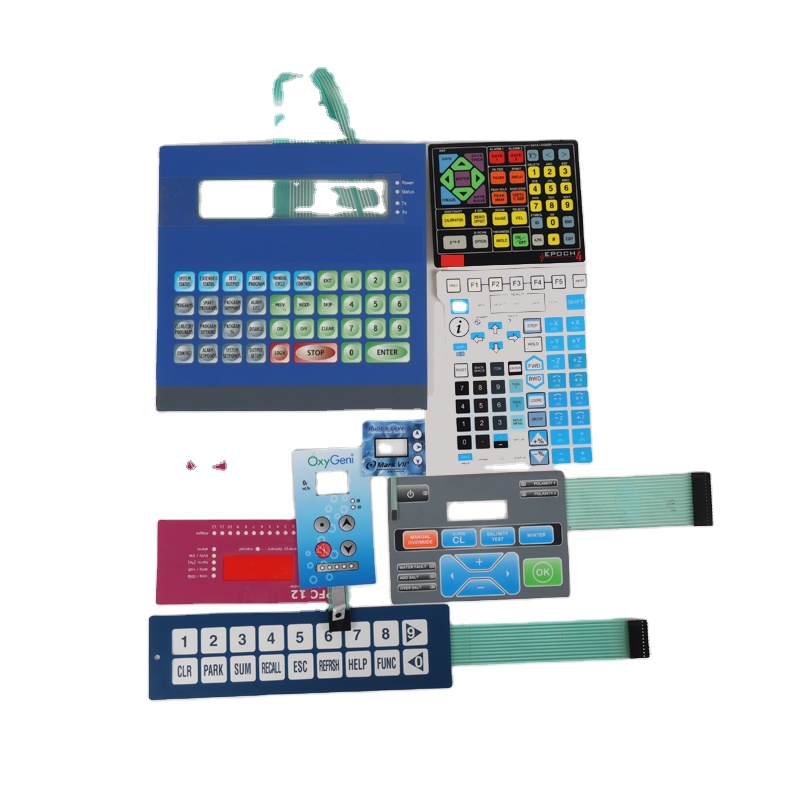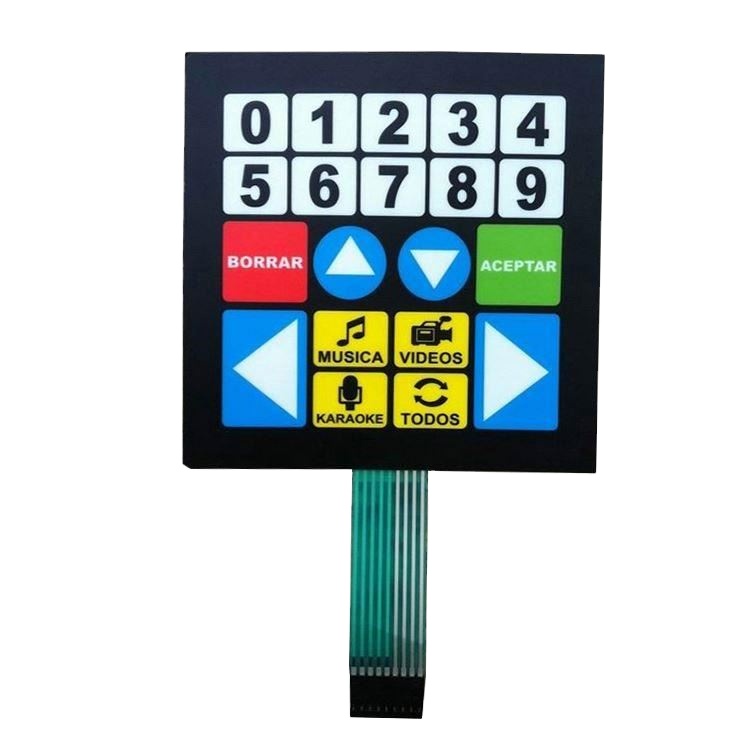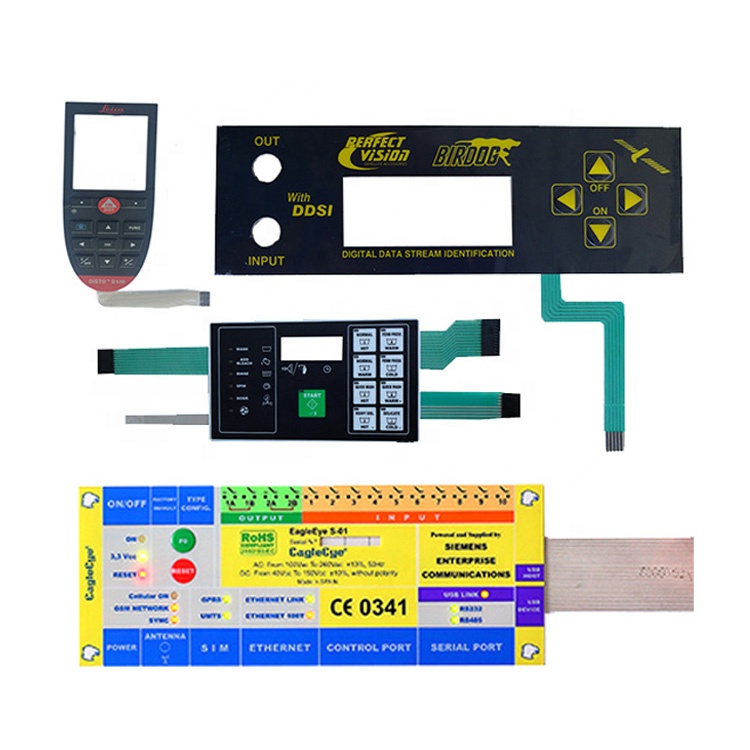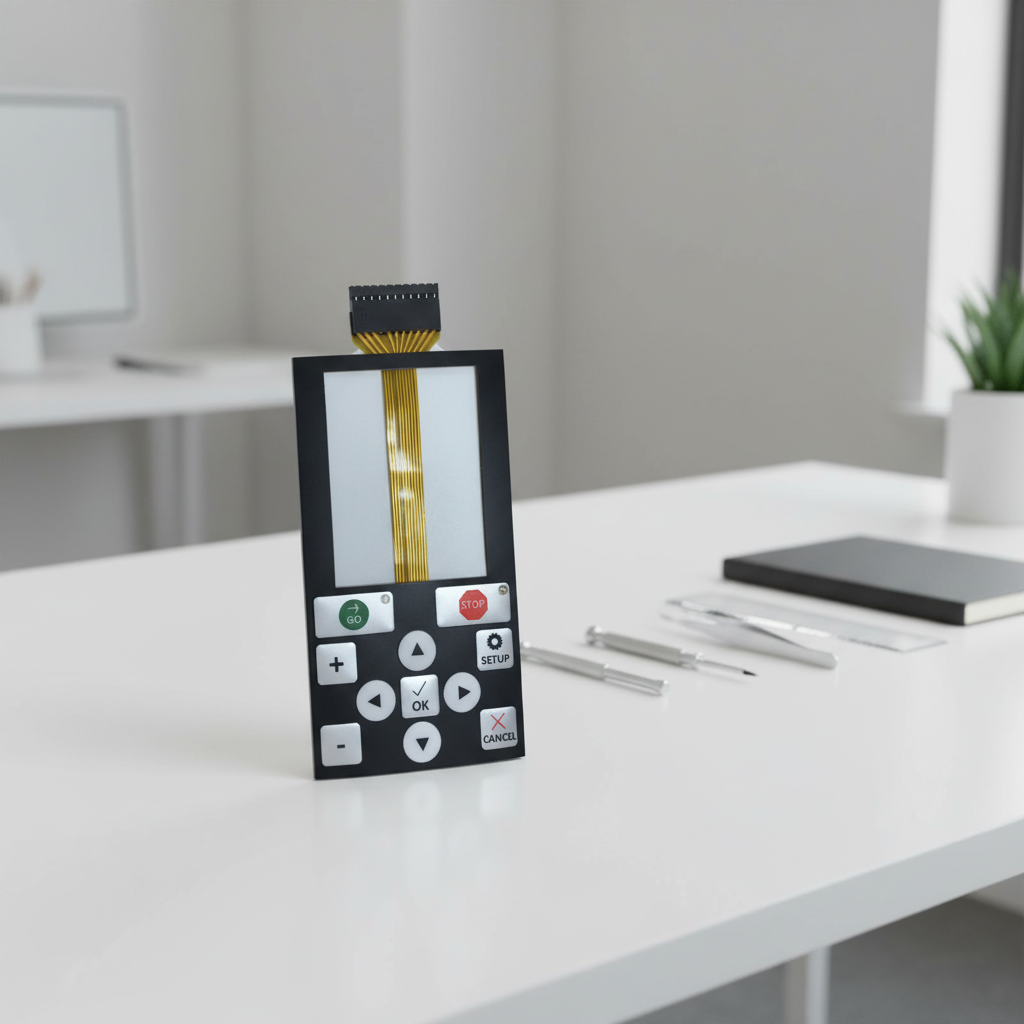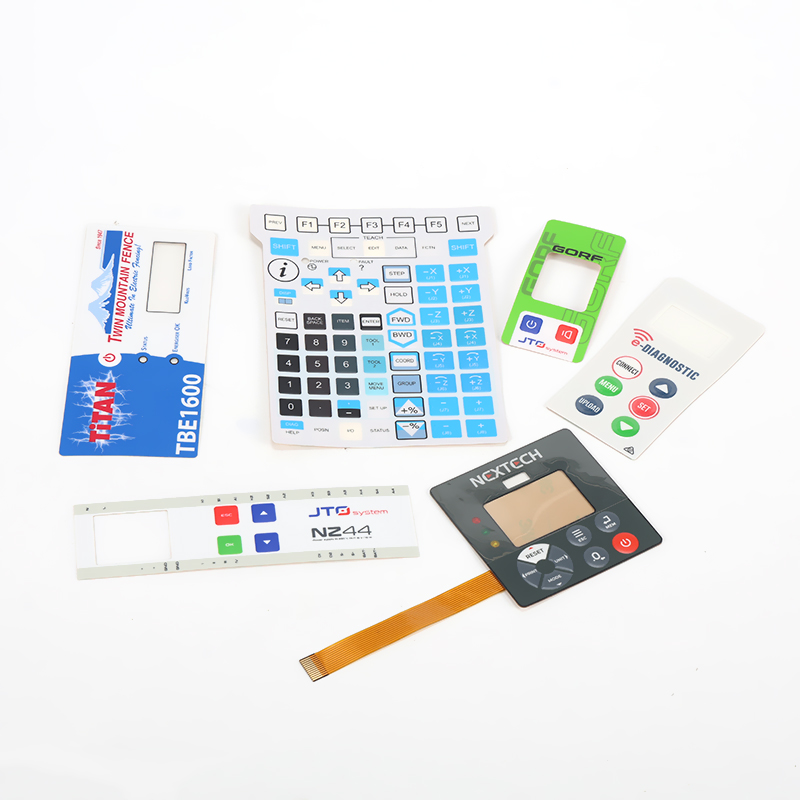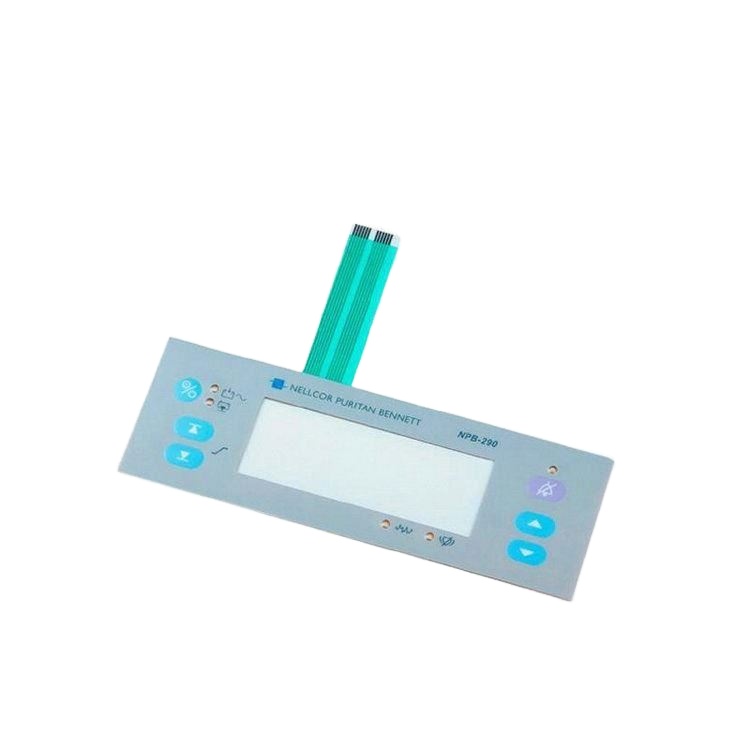
Tactile poly dome configuration, ultra-thin profile, 3M industrial adhesive backer, customizable pin-out pitch for agritech controllers.
Every HMI module is custom manufactured to your engineering drawing with 100% circuit testing, verified Shore A hardness matching, precision laser etching, and IP-rated ingress protection.
Tactile poly dome configuration, ultra-thin profile, 3M industrial adhesive backer, customizable pin-out pitch for agritech controllers.
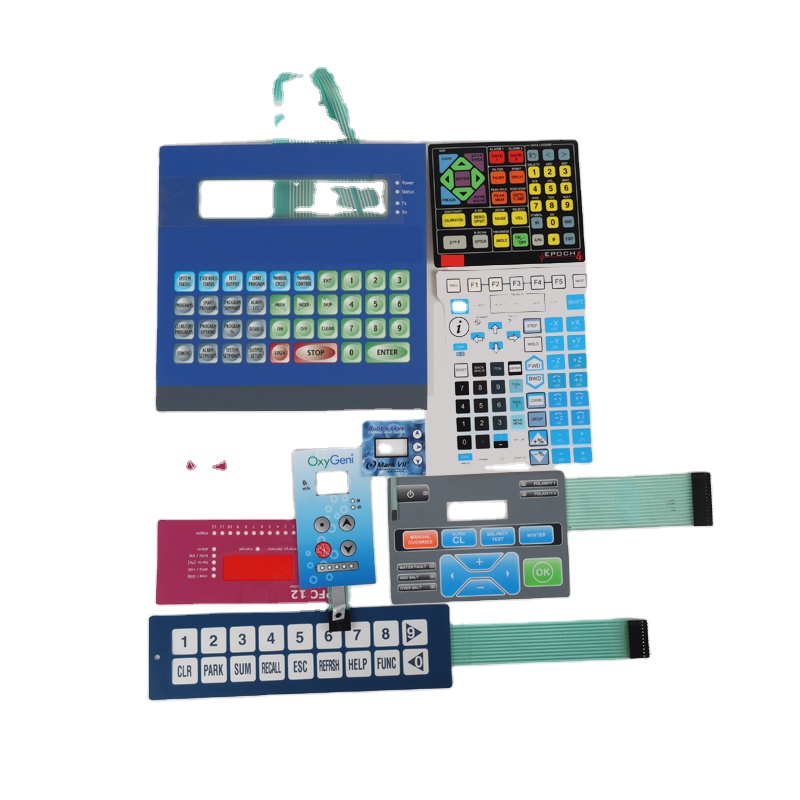
Integrated Light Guide Film (LGF), low power consumption, uniform illumination, designed for night-vision marine and aviation consoles.
Antimicrobial Autotype PET overlay, resistance to hospital-grade disinfectants, 2.54mm pitch FCI connector, hermetically sealed.
Stainless steel domes with crisp tactile feedback, perimeter waterproof gasket, suited for outdoor metering and heavy equipment.
Multilayer polyester stack-up, chemical resistant finish, clear LCD display window with anti-glare coating for factory floor HMIs.
Dampened elastomeric core, high shock absorbency, IP67 sealed boundaries, engineered for NZ forestry and mining machinery panels.
Smooth wipe-down front graphic, integrated surface-mount LEDs, IP66 washdown protection for food processing and dairy sheds.
High-UV resistant formulation, hermetically enclosed trace paths, zero oxidation conductive ink matrices for remote climate telemetry.
Navigating trans-Tasman regulatory frameworks requires uncompromised material traceability, electromagnetic compatibility (EMC), and robust physical resistance against aggressive environmental factors.
For New Zealand original equipment manufacturers (OEMs), sourcing components with genuine CE Certification provides a streamlined route to satisfying both the European Economic Area criteria and the Trans-Tasman Mutual Recognition Arrangement (TTMRA). While CE is fundamentally European, New Zealand’s Electrical Regulatory Authorities Council (ERAC) and WorkSafe accept test reports conforming to IEC/EN international standards that underpin the CE mark.
Silicone rubber keypads utilize thermoset liquid or high consistency silicone rubber (HCR) cross-linked through platinum or peroxide curing systems. In Australasian agricultural and medical systems, the selection of raw polymers dictates long-term elasticity, resistance to permanent deformation (compression set), and physiological safety under repeated clinical cleaning or dairy washdown operations.
Every keystroke must deliver definitive feedback and electrical continuity over millions of actuations. Depending on circuit impedance requirements, we configure silicone keypads with conductive carbon pills, low-resistance gold or nickel pills, or mate the rubber web directly to high-reliability stainless steel metal domes mounted on underlying FPC or rigid FR4 PCB backings.
New Zealand’s geographic isolation, coastal maritime boundaries, intense ultraviolet radiation, and prominent primary production sectors present uniquely severe operating environments for human-machine interfaces.
New Zealand is a world leader in automated dairy farming, pasture monitoring, and smart livestock drafting systems. Keypads deployed in dairy sheds encounter daily washdowns with pressurized hot water, sodium hydroxide, and nitric acid cleaning solutions (CIP). Our IP67 and IP68 silicone keypads feature continuous perimeter compression gaskets and silicone-wrapped bezels that completely isolate internal electronics from liquid moisture, urea, and agricultural chemicals.
From commercial mussel farming vessels in the Marlborough Sounds to ocean-going superyachts in the Hauraki Gulf, marine equipment requires HMIs impervious to salt fog corrosion (ISO 9227), dense humidity, and sea-spray immersion. We produce silicone rubber keypads combined with laser-etched backlit translucent legends and optical LGF diffusion, enabling seamless night navigation and daylight readability without saltwater degradation.
The burgeoning biomedical hardware cluster in Auckland and Christchurch designs advanced patient monitors, portable respirators, and laboratory centrifuges. These interfaces require biocompatible, non-toxic silicone membranes compliant with ISO 10993 and CE medical directives. Our silicone mats undergo medical-grade anti-microbial surface treatments that endure continuous wiping with isopropyl alcohol (IPA), bleach, and ammonium chloride disinfectants.
Keypads installed in geothermal regions like Rotorua and Taupo face high ambient levels of corrosive hydrogen sulfide (H2S) gas, which rapidly oxidizes standard copper contacts. Furthermore, New Zealand’s peak summer UV index frequently exceeds 12 due to the thinning ozone layer. We formulate silicone with fluorosilicone additives and apply high-grade polyurethane (PU) or Parylene coatings to eliminate sulfur corrosion and prevent photochemical discoloration.
Choosing the right front-panel architecture dictates lifespan, tooling investment, and operator reliability across Australasian field deployments.
| Evaluation Parameter | Custom Silicone Rubber Keypad | Tactile Membrane Switch (Metal Dome) | Capacitive ITO Touch Panel |
|---|---|---|---|
| Key Travel / Stroke | 0.8 mm – 2.5 mm (Deep, physical ergonomic travel) | 0.2 mm – 0.6 mm (Short tactile snap) | 0.0 mm (Zero travel; requires haptic/auditory feedback) |
| Operating Temperature | -40°C to +150°C (Exceptional thermal stability) | -20°C to +70°C (Limited by adhesive/film transition) | -10°C to +60°C (Controller & sensor dependent) |
| Sealing Ingress Rating | IP67 / IP68 with molded perimeter rib / sealing lip | IP65 / IP67 with perimeter adhesive barrier | IP65 / IP69K (Continuous glass/polycarbonate surface) |
| Ultraviolet (UV) Endurance | Extremely High; silicone backbone is inherently UV-stable | Moderate; requires specialized UV-stabilized Autotype PET | High; protected under chemically strengthened cover glass |
| Glove & Wet-Hand Operation | Flawless; physical displacement operates regardless of water | Excellent; physical dome depression activates contact | Poor to Moderate; requires false-trigger tuning in rain |
| Life Expectancy | 1,000,000 to 5,000,000 actuations per key | 1,000,000 actuations (typical metal dome cycle) | Solid-state (controller/driver failure modes apply) |
| Tooling Investment | Moderate (Steel compression mold required) | Low to Moderate (Die-cutting knives & screen tooling) | Moderate to High (Sensor masks & optical bonding dies) |
*Note: Data represents standardized performance metrics compiled from internal laboratory testing at Zhejiang ZIRA Membrane Switch Co., Ltd.
Hardware design teams across Auckland, Hamilton, and Christchurch are adopting advanced interface paradigms to meet modern IoT and circular economy requirements.
Hardware engineers increasingly reject pure membrane or standalone rubber approaches, converging instead on hybrid assemblies. Combining a compression-molded silicone rubber keymat on top of a polyester membrane circuit or rigid printed circuit board gives products a high-end consumer look with substantial mechanical key travel, while keeping interior costs economical and assembly profiles hermetically sealed.
With smart farm equipment and maritime navigation operating around the clock, translucent silicone molded keypads finished with dual-layer spray coating and ultra-fine laser etching have become the gold standard. By removing the top opaque coat with CNC laser systems, light from surface-mounted LEDs or Light Guide Film (LGF) shines strictly through the graphic symbol, preventing ambient glare in dark wheelhouses or vehicle cabs.
In accordance with New Zealand’s Ministry for the Environment guidelines and corporate Environmental, Social, and Governance (ESG) targets, electronics designers actively seek recyclable materials and zero-halogen compounding. Our factory implements solvent-free screen-printing inks, non-toxic platinum-cured liquid silicones, and adhesives compliant with EU Directive 2011/65/EU and the Basel Convention framework.
Clear answers addressing import compliance, freight timelines, prototype tooling, and material selection for Kiwi OEMs.
In New Zealand, electrical and electronic products are governed by the Electrical (Safety) Regulations 2010 and the Radiocommunications Act 1989, overseen by WorkSafe NZ and Radio Spectrum Management (RSM). While the Regulatory Compliance Mark (RCM) is the mandatory compliance mark for equipment supplied in NZ and Australia, RCM declarations are primarily founded upon international IEC and CISPR testing standards. Because our silicone keypads and membrane switch assemblies hold CE compliance (conforming to the EU EMC Directive 2014/30/EU and Low Voltage Directive 2014/35/EU), our comprehensive laboratory test reports, RoHS 3 test summaries, and flammability certifications (UL 94) directly satisfy the technical dossier requirements for your local RCM compliance filing.
Our manufacturing plant is located in Ningbo, Zhejiang Province, home to the Port of Ningbo-Zhoushan—one of the world's premier maritime transport hubs. For production orders shipped via ocean freight, direct container vessels sail regularly to the Port of Auckland, the Port of Tauranga, and Lyttelton Port (Christchurch), with average ocean transit taking 14 to 21 days. For urgent engineering prototypes, pilot runs, or high-value small batches, we dispatch through DHL, FedEx, or UPS air express directly from Ningbo or Shanghai Pudong International Airport, reaching engineering desks in Auckland, Wellington, or Christchurch within 4 to 6 business days after dispatch.
Unlike standard off-the-shelf plastic parts, custom silicone rubber keypads require precision compression tooling fabricated via high-precision CNC machining and EDM (Electrical Discharge Machining). To support research and development initiatives, university spin-offs, and pilot production runs across New Zealand, we offer flexible prototype tooling programs allowing engineering sample batches starting from as few as 10 to 50 pieces. Once functional geometry and tactile characteristics are fully verified and approved by your R&D team, standard commercial production orders typically start at 500 to 1,000 units, offering optimal per-unit amortization of tooling investments.
New Zealand's seasonal ozone depletion generates exceptionally harsh ultraviolet radiation (UVA and UVB bands), which can cause photo-oxidative degradation, surface tackiness, or yellowing in low-grade synthetic elastomers. At ZIRA, we use high-purity virgin dimethyl silicone rubbers formulated with UV light stabilizers (HALS - Hindered Amine Light Stabilizers) and inorganic ceramic pigments with high colorfastness ratings. For keys with printed symbols, we seal legends underneath a high-solid polyurethane (PU) or fluoropolymer topcoat. This protective barrier is rated to endure thousands of hours of accelerated QUV weathering without cracking, peeling, or fading.
The choice between conductive carbon pills and metal domes depends on the user ergonomics and electrical requirements of your device. Conductive carbon pills molded directly into the underside of the silicone key actuator offer soft, quiet keystrokes, longer travel (1.0 mm to 2.0 mm), and exceptional cycle life exceeding 3 million actuations. This makes them ideal for handheld remote controls, clinical monitors, and heavy industrial pendants. Conversely, if your application demands distinct tactile feedback (a physical "click")—such as outdoor agricultural meters where operators wear thick leather or rubber gloves—we integrate stainless steel metal domes directly underneath the silicone mat or onto an adjacent membrane layer.
To initiate a comprehensive Design for Manufacturability (DFM) review, our engineering department prefers 3D CAD models in STEP (.stp) or IGES (.igs) format detailing the silicone keycap geometry, draft angles, web thickness, and actuator pill locations. For graphic overlays and silkscreened/laser-etched legends, please supply vector files in Adobe Illustrator (.ai), CorelDraw (.cdr), or high-resolution vector PDF format with specified Pantone (PMS) or RAL color codes. If you have an existing circuit schematic or pin-out requirement for integrated membrane tails, connector pitch, or tail reinforcement, include a 2D DXF or DWG drawing. If CAD files are unavailable, our engineering team can reverse engineer a physical sample sent to our facility.
We support various Incoterms depending on your procurement infrastructure, including FOB (Ningbo/Shanghai), CIF (Auckland/Tauranga), and DDP (Delivered Duty Paid). Under DDP terms, all import documentation, customs clearance fees, New Zealand Customs Service tariffs (custom silicone keypads typically fall under HS Code 8537.10 or 8538.90), and the 15% New Zealand Goods and Services Tax (GST) are settled upfront by our freight partner, allowing delivery straight to your warehouse dock with zero administrative friction.
Quality management at ZIRA is governed by our Intertek-audited quality management system. Every production lot undergoes automated incoming material inspection for polymer hardness, tear strength, and chemical purity. During compression molding, curing temperatures and press pressures are digitally logged to prevent under-curing or voids. Finished assemblies pass through automated optical inspection (AOI) to verify legend alignment, followed by 100% computerized electrical continuity and insulation testing to guarantee zero circuit shorts or unacceptably high contact resistance before vacuum-sealed packaging.
From initial tooling EDM to cleanroom screen printing and vulcanization presses, we maintain total control over your HMI supply chain.
Our in-house mold shop utilizes multi-axis CNC milling centers, precision EDM sinker equipment, and optical grinding tools. By controlling toolmaking in-house, we turn prototype compression tooling around in as few as 7 to 10 working days, adjusting draft angles, webbing thickness, and key travel to match your product's industrial design.
We operate 5 high-capacity vacuum compression molding presses ranging from 200 to 500 tons clamping force. Temperature-controlled heated platens provide uniform vulcanization across multi-cavity tools, eliminating localized shrinkage, air entrapped bubbles, or incomplete web formation in intricate multi-key elastomeric arrays.
Reliability cannot be assumed; it must be verified. Our testing department subjects every completed keypad switch assembly to computerized circuit continuity checks, key actuation force testing, dielectric insulation breakdown tests at 250V DC, and contact bounce analysis, ensuring field reliability in mission-critical applications.
Whether you require a custom Shore 50A silicone rubber keypad with laser-etched backlighting for maritime radar, or an IP68 hermetically sealed membrane switch for South Island dairy automation, our technical engineers will review your drawings and provide a DFM report within 24 hours.