The Ingress Problem: Why Standard Membrane Switches Fail in Harsh Environments
Traditional membrane switches rely on basic pressure-sensitive adhesive (PSA) borders to isolate internal circuit layers from the external environment. However, when deployed in outdoor marine consoles, agricultural automation, or medical wash-down workstations, atmospheric pressure differentials, capillary moisture migration, and harsh thermal cycling (-40°C to +85°C) will inevitably compromise standard adhesive perimeters. When ambient air inside a switch heats up and expands during system operation, it forces microscopic egress pathways through the adhesive seal. Upon cooling, moisture, chemical vapors, and condensing humidity are siphoned directly onto internal silver conductive traces, accelerating electrolytic silver dendrite migration and causing irreversible electrical shorts.
Sealing Architecture: IP67 vs. IP68 Engineering Methodologies
Achieving true IP67 (submersion up to 1 meter for 30 minutes) and IP68 (continuous immersion under defined pressure) performance requires complete structural re-engineering of the switch stack-up. At ZIRA, we deploy three fundamental design principles:
1. Continuous Hydrophobic Perimeter Gaskets: Instead of simple perimeter cuts, our engineering team utilizes high-tack, cross-linked acrylic adhesive systems (such as genuine 3M 300LSE, 3M 467MP, or custom silicone-foam gaskets) with a continuous width of at least 3.0mm to 5.0mm around all active circuits and venting traces.
2. Dynamic Internal Breather Vents with ePTFE Hydrophobic Membranes: To balance atmospheric pressures caused by mechanical button actuation and fluctuating temperatures without allowing moisture ingress, we channel internal venting through rear enclosure channels lined with expanded polytetrafluoroethylene (ePTFE) membranes. This micro-porous barrier allows gaseous pressure equalization while completely repelling liquid droplets, oils, and particulate contaminants.
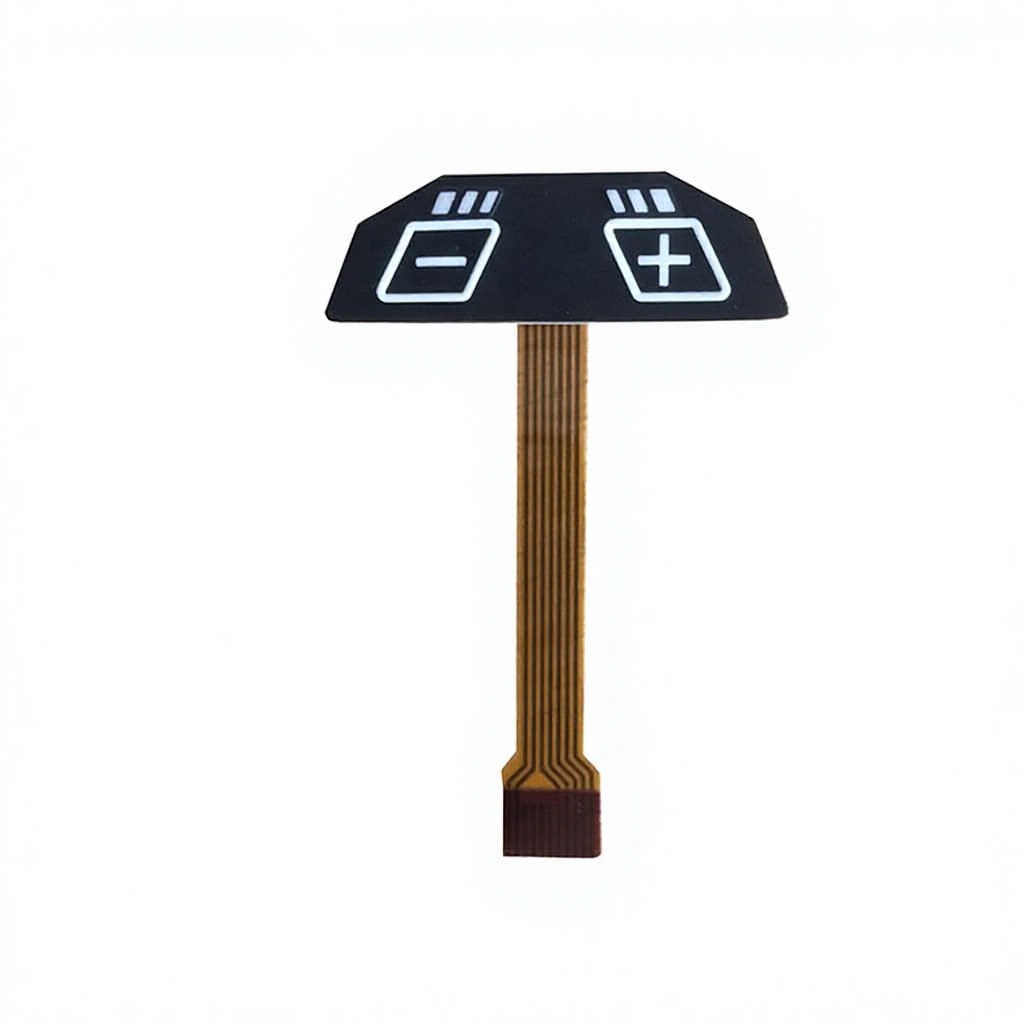
3. Conductive Trace Encapsulation & FPC Substrates: For high-humidity and wash-down medical interfaces, we replace standard screen-printed silver ink traces on untreated PET with Polyimide Flexible Printed Circuits (Copper FPC) plated with ENIG (Electroless Nickel Immersion Gold). Furthermore, whenever screen-printed silver circuits are required for cost optimization, our automated screen printing lines coat all conductive silver tracks with a protective carbon dielectric overcoat, eliminating galvanic corrosion and trace cracking under heavy duty cycles.
| Performance Parameter |
Standard Commercial Membrane |
IP65 Weatherproof Membrane |
IP67 / IP68 Fully Sealed Industrial (ZIRA) |
| Perimeter Seal System |
1.5mm Standard PSA Border |
2.5mm 3M Adhesive Matrix |
Continuous 4.0mm+ 3M 300LSE / Acrylic Foam Gasket |
| Internal Pressure Venting |
Open Side Venting to Air |
Internal Maze Venting to Tail |
Rear-Channeled ePTFE Hydrophobic Breather System |
| Circuit Substrate Type |
Silver Ink on Treated PET |
Silver Ink + Carbon Dielectric |
Copper Clad Polyimide (FPC) or Carbon-Sealed Silver |
| Operating Temperature |
0°C to +50°C |
-20°C to +70°C |
-40°C to +85°C (Extended Environmental Range) |
| Tactile Life Expectancy |
500,000 Actuations |
1,000,000 Actuations |
1,000,000 to 5,000,000 Actuations (Stainless Domes) |
| Chemical / UV Resistance |
Low (Standard Gloss Polycarbonate) |
Moderate (Textured PC) |
Exceptional (Hard-Coated Autotex PET / Silicone Mat) |
Substrate Material Selection: Polyester (PET) vs. Polycarbonate (PC)
Specifying the proper graphic overlay film is critical for longevity. While Polycarbonate (PC) offers high optical clarity and initial cost benefits, it exhibits poor flex life and quickly degrades when exposed to UV radiation, hydrocarbons, and standard industrial chemical solvents like isopropyl alcohol and caustic wash detergents. For rigorous industrial applications, ZIRA standardizes on chemically stabilized, biaxially oriented polyester films (such as MacDermid Autotype Autotex XE). These polyester overlays demonstrate a flexural fatigue endurance exceeding 5 million switch actuations without micro-cracking, while offering superior resistance to yellowing, embrittlement, and environmental stress cracking (ESC).